Showing posts with label Worldbuilding. Show all posts

Wednesday, May 31, 2023

A Pair of Rosa System Paintings

Well hello again.

Recovering from the post-college brain emptiness is a slow process so far, but I've managed to rally together to paint two pieces in as many nights - so it's time to share!

(Be sure to open these up to see them at full res!)

The first one here has a bit more of the creativity I've been looking for lately. This started as more of a doodle than anything but eventually became a more involved visualization of the Rosa system as a whole. The scales are not accurate of course, and I've talked plenty about the order of the worlds, but it was fun to properly depict the whole system in an artistic but structured way, like you might find on a NASA webpage or in the kind of books I read as a kid.

Obviously we have Rosa, the parent star, and her three little worlds. Today, we use a default naming scheme for exoplanets in which the star is considered object "a," and its worlds (in order of discovery, or just distance) are named starting from "b." Exoplanet enthusiasts from a particular Discord server will be happy to note that I've amended my embarrassing 3AM mistake of starting with "a."

As mentioned many a time on this blog, this is a pretty compact system, with a pretty small star - Rosa is only about the size of Jupiter (but considerably more massive), and her children, each smaller than Earth, orbit much closer than Mercury does to our own Sun. They're probably locked in some kind of resonance that makes their orbits stable over billions of years. I considered adding a greenish disk to represent Rosa's habitable zone, as I've seen in other representations, but since all three worlds are settled I figured that might be a bit redundant.

I haven't talked about the Outer Disk much on this blog, mainly because it's remained a nebulous concept in my head for some time. The Outer Disk is a population of small, mostly icy bodies lying out beyond Orus (Rosa d, the most distant planet). Its existence makes sense to me in a cosmological way, but I think it may be quite depleted by the time of the story. Long before our narrative begins, humans in the system harvested the majority of these objects in their conquest of the stars. With their disappearance, the fate of this material is unknown to the reborn civilization. As the people of the Rosa system began to reconnect and return to the skies, they turned to the remnants of this disk for raw materials once again. Almost all remaining mass in the Outer Disk was eventually deconstructed in support of infrastructure, including massive orbital foundries in orbit of Orus, vast fuelling depots, and the grand interworld castles that cycle amongst the planets. To this day, there may in fact be some very traditional space settlements (small pressurized habitats! The novelty!) scattered amongst the debris out here, and this could even figure prominently in the story.... I'll have to noodle about that one.

In any case I had an interesting time making that disk look right. I used the more granular tool with bigger particles to paint a disk, and spent a lot of time trying to shade it convincingly to be orbiting the central light source. I experimented with some radial spoke shadows but couldn't get them to my liking. When I finally added the finer cloud as an afterthought, it actually did a lot to sell the overall effect, so I guess that's a nice win.

The painted background was fun to do, with its sweeping brushstrokes and varying hues. The glow effect was a neat little innovation for me - I started with just a basic airbrush glow, then used a brush with no paint to sort of smear it into visible strokes while maintaining its transparency. It feels a little more organic and less sterile, which I'm always a fan of.

On to the next one!


This was tonight's work, and I tried to bring over the same energy as before. Rosa is rendered in the same way, and I used similar techniques for the (much subtler) background and the painted glowy bits. The approach to painting the planet was less involved than in a previous lineup I did - fewer layers, and more emphasis on just overall vibes for this one.

Here we have Orus, an icy ocean world on the fringe of habitability. Its distance from Rosa and slow rotation period result in extreme day/night variability, in effect more like short seasons than days. Orus' population runs on an irid'An-based schedule, with recurring "days" just 15 or so hours long, and Orus' seasonal cycle takes around 24 of these days to repeat. The global ocean freezes over during the dark Vigil, and warmth when Rosa is overhead is still fairly minimal. The world never seems to escape its biting winds and terminally capricious overcast skies.

In the distance, closer to Rosa, we have pr'Sefone (top left) and irid'An. The former generally appears to be a tidally locked desert world from afar; only close inspection reveals the temperate band of settled land lining its terminator. The lush irid'An practically glows with brilliantly reflected Roselight, a result of its own, significantly more pleasant world ocean.

Overall this piece definitely feels like an improvement over the previous single-planet highlight I made of pr'Sefone. I'm enjoying using these warmer, more saturated hues, and some more creative techniques to shy away from photorealism. Both of these pieces feel more inspired and alive than older ones I've done, even if they're a bit less intricate. I like this style a lot and will be hoping to develop it further in due time.

That's all for now - one of these days I've got to get to sleep at a reasonable hour....

Wednesday, May 17, 2023

Kent-Boreus KB404

Kent-Boreus is an interworld shipping company in Roselight. Not one of the more luxurious providers, KB is generally more cargo-oriented, with its few passenger routes having longer transit times and more spartan accommodations than their competitors. Nevertheless, they find their niche in high-volume cargo transportation between Rosa's Children, shuttling heavy payloads between growing worlds.

Their flagship vehicle is the KB404 hauler, the classic midsize cargo vehicle of the fleet. Similar in form to standard castle tenders, the KB404 is nevertheless much larger. Traditionally air-launched from exceedingly large rigid airships, the ubiquitous KB404 was one of the first to be adapted to use with the Orus Skywheel. Significant structural reinforcement has taken a bite out of its payload margin, but the reduction in fuel mass more than accounts for the extra material. Over time, many have been refit with smaller propellant tanks to accommodate greater cargo volume.

The KB404 flight profile begins with either a propulsive ascent from an aerial launch platform, or a momentum exchange from the Orus Skywheel. Either case sends the vehicle on a ballistic interworld trajectory, on the order of 5 to 10 days for most routes. Small course corrections and traffic avoidance maneuvers are made as necessary while the crew and cargo coast in microgravity towards their destination. Upon arrival, four actuated body flaps guide the vehicle along its simple, high-drag entry and descent profile. Below around 5 kilometers, the aerostat envelope is deployed by a series of pyrotechnics and rapidly inflated with lifting gas from a decomposition reaction. Once in stable drift, the hauler is retrieved by aerial tugs and refit for its next flight.

Though nominally crewed by up to eight flight officers, the pool of qualified pilots for Skywheel flights is much smaller. Smaller crews find themselves living in greater luxury, in exchange for extremely strenuous g-loading during launch.

Roselight would acquire an aging KB404 shortly before the Drenna Statute and ASMC's de facto implementation of martial law on Orus. This vehicle would be instrumental to the survival of Roselight's revolution in the following months, allowing a small group of insurgents to penetrate the transportation blockade en route to irid'An.

And now for a bonus image of Noira in the observation deck...


I also recently painted this scene of a similar vehicle departing irid'An, with Orus looming in the background. While this smaller craft is likely a ship tender, it still provides a decent concept of what the KB404 might look like in flight.


Thursday, January 12, 2023

Rosa's Children


You may want to view the above image at full-size! Blogger compression takes a lot out of it.

I had a blast with this painting of the three inhabited worlds in the Rosa system. Only pr'Sefone had previously been depicted from space, so I figured I'd take a step back and try to render the other two in this more familiar sci-fi lens. The sizes were just eyeballed, but are intended to be pretty representative. The direction of Roselight indicates the relative ordering of the planets as well. A quick breakdown:

pr'Sefone, the small, innermost world, is tidally-locked and so resembles what many have termed a "hot eyeball planet." The Roselit side is a scorched desert, while a narrow band of temperate climate exists right along the day-night terminator. Deeper in shadow, a mysterious tundra wasteland looms in the eternal darkness. I've depicted a bit more surface water than previously envisioned; I think we've got some rivers and perhaps dammed artificial lakes now, in addition to more ancient dried rivers and deltas. I like to imagine pr'Sefone had dramatic canyons and waterfalls and such globally before it became tidally locked; most of those features are now lost in tundra or desert. The green is, technically, Earthly vegetation, although in Roselight's setting it's perhaps thousands of years removed. I've also depicted the primary spaceport out of Eterna, pr'Sefone's capital city, near the north pole.

irid'An is a lush, tropical ocean world, with a few small archipelagos and atolls springing forth from the gentle, temperate sea. irid'An is the most Earthlike of the three, with a rapid rotation period of around 15 hours and an atmosphere supporting lots of dynamic convection and such. Small ice caps are present, probably composed entirely of transient patches of sea ice. I had a lot of fun with the clouds; I duplicated the cloud layer, darkened it, and offset it slightly to get the shadow effect, even offsetting different portions at different distances to mimic the changing light angle.

Orus is the largest and most distant of the three, and is similarly covered in a deep ocean, albeit colder and more turbulent than that of irid'An. The islands jutting from the chaotic waves are harsh, rocky, and barren. Orus is a slow-rotating world, not quite tidally locked, but sluggish enough to generate pretty big temperature swings between the temperate days and absolutely frigid nights. The ocean gradually freezes over when Rosa dips beneath the horizon, making Orus resemble a "cold eyeball planet" despite retaining a day/night cycle. I did illustrate this, but it's barely visible at the terminator under the cloud cover. Incidentally, the cloud pattern is inspired by that of Venus' similar slow-rotating atmosphere when viewed in infrared.

More on each of these worlds can be found on the "The Rosa System" page up at the top of the blog! And, of course, lots of worldbuilding and relevant artwork can be found using the tags in the left column.

Monday, January 9, 2023

Timekeeping

 Sunrise and sunset? Nay, we have rosris (ROZE-eye) and rodin (ROW-din).

What follows is a sort of haphazard study of timekeeping in Roselight, and its relationship to the culture of the Rosa system’s inhabitants. As some ground rules, I’m going to maintain the use of hours, minutes, and seconds, but everything else…….we’ll see. Also, be advised this was all typed at like 3 AM so it may or may not be totally coherent.

I think irid’An has a day length similar enough to Earth that the people there can live a recognizable day/night schedule; maybe substantially shorter than ours, like 14 or 15 hours, where people sleep shorter intervals or maybe alternate whether they sleep a given day or not. I think the natural diurnal functions in our brains are probably more receptive to short sleep periods whenever it gets dark (4 to 5 hours?) so that would likely be the norm on irid’An. Shorter days but a pretty recognizable cycle.

On this world, the physical day/night cycle can just be referred to as consisting of calendar days, which would be the system-wide standard for timekeeping (dates, events, trade, economy, stonks). This is fun from a narrative standpoint as well because it sets the stage for the almost oblivious influence the people of irid’An have over the rest of the system. They’re privileged with a lifestyle that feels so pleasantly familiar that they’ve never known the fundamental upheaval of basic existence that others have had to endure.

On Orus the situation is quite different. The day/night cycle is more like weather variation on a weeklong timescale, not something rapid enough to build a sleep schedule based on. So, as mentioned before, people here probably run on irid’An time. Their clocks would be synchronized, despite the time delay ruling out real-time communications anyways. So people probably rise and sleep on similar schedules to irid’An, perhaps sleeping for longer during the nights and shorter during the days. Here we will need to distinguish between physical day/night and the calendar days.

I’ve been trying to figure out a good alternate name for a calendar day, like “sol,” so that “day” and “night” can mean light and dark. But what if we take the opposite approach? Rename the periods of light and dark on Orus, since in a way they’re more like seasons than days. The climate changes for a significant period of time, but the cycle of life continues. Daytime approaches and shifts into nighttime even as multiple “days” go by. What could we call these periods?

“Vigil” is a phenomenal name for the nighttime on Orus. Continuing the theme of liturgical hours, I like “Laude” for the daytime, but I’d honestly prefer something less biblical for both inclusion and realism (how many thousands of years has it been by now?). I’ll noodle on it some more.

Despite human society being focused on irid’An, while colonization of Orus occurred within the last 100 years or so, people have still developed new cultures and customs suited to this unique world. You’ll find the use of Vigil and Laude to be more prevalent the further you go from ASMC’s upper brass. Those closer to the company (and thus further from the world itself) view these new customs as frivolous and meaningless, while the people in villages and communities most removed from ASMC (like Noira’s friends) have already been raised under these traditions. They began among the working class who sought to make a home of this world they were contractually bound to, and have since spread to people who don’t work for ASMC at all. Noira herself is in the odd position of having lived on Orus for some time, but still being a relative outsider to the inner culture here. She’s largely been a working immigrant to the world, and so spent most of her time in a heavily company-controlled life.

On pr’Sefone things are even stranger, albeit simpler. Rosa does not rise or set, and this world’s orbit is too tightly shepherded after billions of years of resonance to have any appreciable eccentricity. So the only way to keep time is to look beyond Rosa, to the other worlds. Timekeeping here is marked primarily by the passage of irid’An in the sky, as this would’ve been the most important celestial object to the Sefones during the flightless era. This is a lot like how the month on Earth is based on the cycle of the moon, but instead of being something like an orbit, a “month” here might refer to the synodic period of pr’Sefone and irid’An. These worlds’ motion relative to each other repeats on a set timescale that both worlds could observe, so this might even be a formalized calendar definition as well. Actually, the synodic period is very important for spaceflight, so once interworld travel returns this would be a crucial measurement of time.

I’m not sure what wake/sleep periods look like on pr’Sefone – naturally, the onset of “globalization” (multiple globes in this case) means most people on pr’Sefone just follow regular irid’An time, but I wonder what the Sefones did while they were mostly out of contact with irid’An. Maybe people slept in rounds or shifts, set to a natural division of the synodic month. This could be a good tie-in to some of their cultural quirks about vigilance and the constant presence of Roselight in their lives; as Rosa never rests her watchful eye, neither must the Sefones. The influence of universal irid’An time thus becomes an existential threat to a huge part of Sefones culture. This would be a fun thing to explore amidst Noira’s immediate family – maybe some of her younger siblings have already taken on more responsible roles in the family, as someone needs to remain awake and watchful as their mother Telma sleeps.

So that gives us some semblance of an understanding as to timekeeping and its cultural implications in Roselight. I need to sleep soon but my next aim is to try and craft a more comprehensive calendar. Some notes for then include the fact that the planets are probably in resonant orbits, due to the compact size of the system, which may help to keep timekeeping nice and neat.

Wednesday, January 4, 2023

More visions of irid'An

In the past few weeks I've found myself with a lot of extra time for doing art and things, so I figured I'd compile another art post. Today we're looking at irid'An some more!

An important development in irid'An's design is the presence of these volcanic hot springs down in the calderas of some islands. I'm envisioning something sort of like if you took Yellowstone's springs and geysers and transplanted them onto Hawaii. I've kept the idea of boardwalks bridging across some of the thinner crust around these springs, and in some cases even over the water itself. Of course, Yellowstone's "water features" are incredibly dangerous, so on irid'An these sorts of features would only be built where the water temperature allows.

In any case, I love this vision of thriving, bustling marketplaces and such all clustered down in the caldera floor, with lush environments fed by these springs and all sorts of rich cultural settings to be had. Further up the crater rim are the gleaming idyllic cities, home to corporate headquarters, political offices, and rich housing, elevated far above the common people.

Not too much to see here, other than another concept of an island with this central hot springs caldera complex. In this case the heated water outflows into the sea. I've used a rich, reddish-orange color for the soil around the springs, which in Yellowstone's case is the result of microorganisms living in the water. Since these worlds have already been colonized in advance by our own Earthly fauna, we're probably seeing something similar. In the background is not a moon, but another world - pr'Sefone, I suspect. The Rosa system is densely packed, much like the TRAPPIST-1 system, so the other worlds might appear quite conspicuous in the sky.

I'm pretty proud of this one, depite its odd framing (I don't always consider how I'll need to capture the artwork later while I'm making it). This is the logical extension of the previous image, showing an entire atoll of these small islands, and a thriving city distributed among them. This might be the kind of environment I'd like to see for the world's capital. One of the hot springs is under the sea here, creating an effect alarmingly similar to that seen in Shin Godzilla. Hopefully he's not hiding down there.

Finally, something more like a doodle - by now the vision of these islands is well-established, so here we have a ground effect passenger liner crudely rendered on its way towards one of the islands. Although many have steep cliffs rising from the sea (making airships a convenient alternative), this island has a gentle enough grade to permit a busy port to be constructed at the shoreline, reminiscent of Orus. 

That's all I have for now, but I'm happy with the consistent aesthetic I've been able to develop for this world. irid'An has historically been underdeveloped in my brain, which is ironic since it's the most well-developed world in the canon of the story. Hopefully these paintings help to do it justice!

Tuesday, January 3, 2023

Ancient Setting/Beyond the Veil

So if you've read the "About Roselight" page, you may know my original take on the story was a post-apocalyptic sci-fi one, in which humanity flees a solar-system-sized cataclysm and settles on a new set of planets - Rosa's Children. In my head this looked something like the end of Interstellar, where (spoilers for an 8-year-old movie!) Amelia and CASE begin unloading supplies from a spacecraft for a concerted colonization effort on the late Wolf Edmunds' planet. I had pictured society pretty much continuing where it had left off, maybe with some rough spots after being in space for centuries, but nothing too major.

Now, I've already cast aside any notion of hard sci-fi for Roselight, and I'm trying to steer clear of establishing any real details about the apocalypse that drove humanity from its home (other than that it must've been pretty bad). However, I've started to think I might want there to be significantly more time between humanity's first landing in the Rosa system and the setting of the main part of the story.

I'm imagining the initial colony setup begins, but is already at a significant disadvantage - the journey was really rough. A lot of equipment doesn't work after the very long flight, some technology and skills have already been forgotten, and the population was struggling even before landing. It took a monumental effort for even a few people to stumble across the threshold of another world, and it wasn't a strong start. Despite a concerted effort to establish a foothold on several worlds, population collapse decimated the nascent society and left it teetering on the edge of extinction for a few generations. This caused something of an information choke point; for modern society, very little is known about the time beyond the veil, and any truth about what happened to bring us to this point has been totally lost in the landscape of myth and legend. There could well be some interesting mythology that in some way tangentially relates to the truth, but it's hard to know for certain.

Overall, human culture loses a lot of what it used to have - I don't want to say "regresses," because non-industrial societies have so much value of their own, but they do lose a lot of explicitly useful and beneficial stuff like healthcare technology and the lessons learned about sustainability from the old worlds. Sure, these people will be starting anew and living in harmony with the land, but with the loss of detailed knowledge about what happened and where they came from, they're wide open to the possibility of making the same mistakes twice. The context lives on in something of a religious way: of course they're going to retain the sense of being a displaced people, alone in a foreign landscape after something of a fall from grace, dare I say a paradise lost.

One big advantage of the ancient world concept is that it helps to justify the very patchwork technology set I want them to have - a strange mix of old and new, where it's really more about what's practical than being in line with a particular overall level of advancement. The entire manufacturing industry needs to be redone from scratch, so you'll find no microchips here - but computers, jet engines, and spaceflight were once solved and can be rediscovered with some expedience, interpreting ancient texts and instructions with a sense of mysticality.

There's another really interesting thread here. irid'An is the obvious candidate world for human settlement as a Plan A, if you're intending to just set up shop and have it work out (which it won't). pr'Sefone and Orus are comparatively less appealing, but you know they'll be useful so you establish some early colonies or outposts there. Then, the collapse occurs, and suddenly society is crashing so hard that these colonies become isolated from each other. It's possible that radio communications are ritualistically maintained during the long dark, but spaceflight would have entirely ceased, leaving different populations to grow apart culturally and even physically. This opens the door to pseudo-"indigenous" populations that differentiate from each other before the eventual reunification. Furthermore, I sense that while pr'Sefone's offshoot colony might survive and grow pretty well (I'd already conceived of the "Sefones" people), an isolated, skeleton crew outpost on Orus would fare pretty terribly, and might even go fully extinct. Anything they'd learned about this world would be lost behind the veil, and it leaves the world vulnerable to the rampant exploitation we'd see centuries later from ASMC - after all, it's a dead planet that kills anything it touches - surely it can have no further value than to be stripped of its resources and cast aside...

This began as a comparatively minor adjustment in my brain, but the more I type the more I realize there's a lot of potential here to really strengthen the worldbuilding. It's late now, but I definitely need to come back to this and start developing these concepts further. Soon!

Sunday, January 1, 2023

Noodling about Stakes

Mmm, steaks.

No, I've been thinking about stakes, in a narrative sense: what makes them effective, what makes them relatable and engaging, and the implications thereof on the story of Roselight.

I have big, grand plans for the conflict in this story. Perhaps a bit too grand, at least for the short term.

When I talk about "stakes" here I'm talking specifically about the stakes of the conflicts and engagements in the narrative - what do our characters stand to lose? What does their society or world stand to lose? What happens if they fail? How weighty are the tasks and battles they're undertaking, and do they make sense?

An illustrative example is the Star Wars universe. In the so-called "Skywalker Saga," basically every character is highly influential over the fate of the entire galaxy and its trillions of citizens. The main characters are godlike space wizards and chosen ones, prophetic mythological heroes, and the villain is literally evil incarnate. The fate of the entire universe hangs in the balance, and that gets...pretty boring, sometimes. I know the sequels are easy pickings, but they wrote themselves into a big circle where the only meaningful conflict they could think of was to bring back the evil space wizard and have him be literally every evil space wizard put together, with the goal of annihilating the entire universe or something with a vast navy of enormous planet-sploding spaceships.

Contrast some other spinoff media like the extremely engaging Andor series (no spoilers within). Andor focuses on a much smaller scale; our heroes aren't godlike space wizards, they're drifters and washouts and nobodies, people picked up off the street; their objectives are small and local. We know eventually this story will feed into a more high-stakes plot that, in turn, supports the Skywalker Universe Saving Saga of Destiny. Nevertheless, what feel most impactful are those small stakes we can directly relate to and understand - none of us have saved the universe from pure evil before, but we know what it's like to have arguments and complicated relationships with people, or to be in tough situations in life that we can't seem to find our way out of.

As a window into the overarching plot I'm looking at for Roselight, I can offer a quick and dirty outline of what's outlined so far:

  • Noira gets new job after Ark Royal incident, meets friends
  • Friends help Noira come out of her shell
  • On a trip with friends, Noira discovers the company (ASMC) is razing villages and other bad things
  • Noira and friends are hunted by company law enforcement
  • They take refuge at a hideout with a resistance organization (Roselight)
  • Roselight attacks ASMC's razing operation
  • ASMC obliterates Roselight's hideout
  • Roselight flees on a desperate mission to run an exposé on the Company
  • Many more unknown future events?????

This of course largely excludes any interesting character arcs that take place during the story, in favor of highlighting only the most essential points and events.

So the question I arrive at is: what do I want to get out of this story? How high should the stakes really be here?

My Grand Plan, at a glance, reads like Noira being at the spearhead of a planetwide (small nation-state?) rebellion, which can't happen overnight. The story is naturally about her experiencing the world; we follow her narrow perspective pretty closely until we meet Roselight, where we really see the bigger picture of the issues she's been seeing. There is room, when we meet the revolutionaries, for major events to not include her, and for the story to exceed her direct experience.

However, I do really want to have her and her friends be in most of the main arc. The only one of these bullets that I feel comfortable leaving them out of is Roselight's strike on an ASMC razing operation - this doesn't have to include them for its impact on the story to work. By contrast, the subsequent bullet point - ASMC retaliating by annihilating Roselight HQ - should have our heroes front and center to witness and really internalize the consequences of that event and how those impact their character development.

Furthermore, to get exactly into the issue of today, I have a lot of really big steaks stakes written in there right now. The big one I'm having trouble with is Roselight's very existence being threatened, to the extent that people like Noira and her friends - who are pretty new to this whole thing - being involved in the last-ditch effort to save the group. It implies that the org is at a point of having like 12 people left over, with the goal of those 12 people being to save the entire cause and bring down the giant of ASMC.

There's a couple ways I can deal with this, and a lot of them are mostly just "think about the logistics of the story for 5 more minutes." Some points that could help:

  • Roselight is not down to like 12 people. The base of operations that is razed catastrophically is a huge loss of power, but mostly leaves the group homeless rather than decimated. There will certainly be significant casualties, but there's still a structure and chain of command and groups of people doing different things. There are also other places they can operate out of - they've just lost a lot of equipment and their big foothold. They're scrambled and lost, but they can regroup with a lot of work.
This is also important for them to even be able to execute their exposé plan; I'm envisioning a lot of infiltration and espionage that means you still need some deep connections and good hardware available. To this end, I think the island of Cantor, which is what I've been calling the Roselight HQ place, is primarily an airbase, the place they stage the interdictors and some combat ops out of. It's the obvious strategic target for ASMC to eliminate, it's most easily traceable after the attack, and it cripples the organization, but it's not like.....the hideout where the entire resistance lives.

Also, the "last-ditch" exposé plan is probably not that critical, in the sense that it's not the only shot they have left at survival. When I originally conceived of the idea, I thought the destruction of Cantor was a great way to up the ante for the exposé - now they have to succeed, as it's all they have left, fleeing directly from the ruins of Cantor to ASMC headquarters on irid'An. Realistically, a resistance group like this, though not swimming in personnel and capital, has the ability to do multiple things at once; the exposé is a very important mission for their future, and will still be the centerpiece of their activity after the razing of Cantor, but it's not quite a desperate dying breath.

  • Remember that the goal is not to save the world. We're focused on one planet, Orus. And, we're not trying to save it from destruction, or even to bring down the big bad company ruling over it, ASMC (although a healthy dose of trust-busting may be in order). Roselight learned from the destruction of Cantor that it can't handle everything on its own. The resistance is hoping to run this exposé on ASMC, which is really just meant to bring its crimes into the public eye and force the hand of the Rosarium government. They're fighting to be treated like people; the degree to which that changes the status quo is up for negotiation if ASMC can at least just NOT RAZE ENTIRE TOWNS.

  •  The plot doesn't happen overnight. As I mentioned before, Noira and friends aren't going to end up on the front lines after being at Roselight for a week, but I can give them more things to do, more intermediate steps. It will take them some time to grow acclimated to the environment and to the cause; they need to gain experience and get more involved in the group before they would ever feel comfortable volunteering for that mission, let alone actually be allowed to participate by the chain of command.

Those interim plot points can occur in multiple places; prior to the destruction of Cantor, Noira and friends might be helping with gathering intel and equipment for the attack on ASMC, or otherwise laying the foundations for that work - or, as above, for other things that Roselight might be working on at the same time. It can also be before the destruction of Cantor, to allow our characters to contribute to the big mistake that has big consequences. Room for development!

I think those are definitely the big notes for now. It's worth noting that high stakes are not necessarily a bad thing in a story, if they can be tempered and contextualized. What I don't wanna do is to drop my characters abruptly into a situation where they're responsible for saving the world - they have to naturally develop into that role. Really, I don't have a great idea of the time scale of the overall story (or, for that matter, how that's even measured in-universe), and I think the things I want to have happen lend themselves to a longer story duration.

There's tons of room to incorporate all kinds of fun character interactions and arcs into this. It's one thing to have big obvious story points, and it's another thing entirely to stitch those together. I don't want the overall story to be a vessel serving no purpose besides transporting the plot from A to B to C - again, the events should progress naturally in between, and it's going to be the much smaller-scale stuff that makes that happen.

One last bit before I forget - I'm in the early stages of formulating new characters that our trio of kids will meet when they first take refuge with Roselight. We need to have some known members of the resistance, and I'm looking forward to developing them in time. Some names have popped into my head: Donner (he/him) and Kierstyn (she/her). These two might be closer to peers of our protagonists, or they might lie higher in the command structure, occupying leadership roles - I'm not sure yet, but the structure and details of Roselight itself are a whole new can of worms that I'm not going to open right now.

That's all for this one - mostly a log of my own storymaking process. Also, happy 2023! Here's to many more posts in the new year.

Monday, November 28, 2022

Tenian

The E-series comprises some of the largest vehicles produced by Grand Ark Aeromarine, the E608 being a late entry in the family. Though nascent jet power has only recently been reestablished, GAA has leaned heavily into the cutting edge for this vehicle. Powerful embedded liftjets haul its bulk into the ground effect, where it cruises at high speed under its four sustainers. An enormous flatbed upper deck allows all but the most unwieldy cargo to be rapidly delivered far and wide across Orus' turbulent seas.

As is standard for the Arcturus Meridian fleet, Tenian has had several deck-mounted guns installed, but this vehicle has also been outfitted with an unusually comprehensive security complement. As ASMC perceives increasing threats to its operations, defensive capability has been held paramount....

Monday, November 7, 2022

Skyhooks and spacecraft

I've got a couple of new doodles today, mainly of two spacecraft as well as the rotovator I alluded to in some earlier posts. Let's look at the two spacecraft up close first!

These are two different vehicles drawn notionally to scale with each other, though they have a lot in common. Above we have the passenger tender, a smaller vehicle designed to ferry people to and from those big artificial gravity spaceliners. Below is a cargo freighter, with a much larger volume for shipping between worlds in the Rosa system.

Both of these spacecraft are powered by chemical rocket engines mounted in the back, with propellant stored fore and aft of a centrally located payload bay. In addition to some reaction control thrusters, both are equipped with some kind of metallic heat shield for atmospheric entry. Both reenter skydive-style, pancaking into the atmosphere, stabilized by four drag flaps (two of which are fixed). Finally, to accommodate the unique terrain and infrastructure available in the Rosa system, both vehicles deploy large inflatable lifting gas envelopes from dorsal compartments, arresting their descent until they become inert aerostats that can be manipulated by other vehicles.

Critically, these weirdos are both air-launched, in a way, although here we see some major operational differences. The passenger tender is air-launched "conventionally" as we might think of it today: carried beneath an aircraft (albeit a large airship rather than a fixed-wing aerodyne), dropped, and powered into space by its own propulsion. The tender must accelerate all the way up to escape velocity during this burn, which is made easier by the relatively small mass of the worlds in this system. As previously described, the tender can then rendezvous and dock with the spaceliners, which will hold them in transit before releasing them to perform atmospheric entry.

The freighters are a bit weirder, being integrated with the skyhook system; I've already talked about this, but due to generally lower g-limits for cargo compared to crew, freighters are well-suited to getting yoinked into space by the enormous sky pinwheel. Doing some preliminary math implies this could easily put them on interworld trajectories, so they could potentially use even more of their volume for cargo, with very little dedicated to propulsion at all - cool! That said, the scaled-up tender version with its vast fuel tanks and engines is still used quite a bit since the skyhook/rotavator/spintowininator (note to self: name it properly) is only available when travelling from Orus to another destination.

Here's some more sketches of these dudes:


Notice the much wider planform of the freighter and its beefier engine section (only present on some models!). At bottom-center is a depiction of the freighter exchange process: three hybrid cargo carrier airships have aligned in formation, each carrying three freighters in a line down its back. Arriving in sync with a rotovator endpoint, all 9 spacecraft are lifted off the decks and begin the long climb to escape...at lower left is an exaggerated depiction of the multi-armed rotovator concept I've been thinking about, with six separate endpoints. At the top of their arc the spacecraft all separate at once, firing RCS in an enormous plume to disperse from each other, the grid formation uniformly expanding as the tether curves away beneath them.


Finally, here's a dramatic angle of the rotovator hub as it orbits languidly above Orus. The center is probably a command station home to a team of traffic controllers, working overtime to keep this mega-infrastructure (infra-megastructure?) running smoothly.

One of these days I want to model both spacecraft, perhaps in Solidworks so I can try for pretty accurate geometry. But that's a project for another time. That's all for today!

Thursday, November 3, 2022

The Founder-Processor


As described in the recent plot outline post, the Founder-Processor is a horrible monstrously large machine that smelts and refines raw ores and rubble into slightly more useful end products. It lies in the bottom of the pit, laboring like an enormous bloated dying animal, smoke billowing from its internal furnace as it vomits forth processed material onto its conveyor.

The Founder-Processors are only mobile to allow them to adjust as the mine grows ever wider and deeper. They are largely constructed on site, and either deconstructed or abandoned to die when a mine's resources are thoroughly exhausted. After encountering one on her first night voyage aboard Ark Royal, Noira is haunted by nightmares of these great beasts lumbering over the landscape, laying waste to the worlds...

Wednesday, November 2, 2022

More on infrastructure

 With the wonderful suggestions of some friends, I've developed some additional ideas about interworld travel, with an emphasis on some infrastructure stuff. For context, we know the Rosa system features a number of large interworld spaceliners on cycler orbits, tethered by long cables to slag counterweights so they can be spun up to produce gravity. The size and mass of these liners (I'm imagining up to 500m in length, for the largest) suggests in-space construction - and I mean real in-space construction. Not modules being docked together, but rivets being driven by actual people in space. This further implies the existence of big orbital shipyards where this stuff can be built, as well as additional space infrastructure like tugs and such for moving cargo between orbits.

The big addition to the lore here is going to be a dedicated skyhook (or multiple!) in orbit of Orus. Since the vast majority of the system's heavy metal resources are mined and processed here, it's long been the focus of infrastructure (take a shot) for shipping and handling lots of cargo. The sustained need to hurl huge amounts of mass skyward will spur the construction of this as-of-yet unnamed megastructure.

As a quick recap, a skyhook is sort of like a partial space elevator. Instead of being affixed to the ground, such a structure is placed in a low orbit and only extends partially down into the upper atmosphere, and equally doesn't stretch too much higher - a total length on the order of hundreds of kilometers. The key is that the structure rotates - tumbling end-over-end much like the cyclers do. The idea is that the end swings backwards relative to its own orbit as it approaches the planet's surface, reducing the relative speed. So, you have a skyhook dangling from space and moving relatively slowly, which can be intercepted by a vehicle launched from the ground. As the tether rotates, payloads attached to the end get flung up and out of the atmosphere. Detaching at the highest point will send you into a still-higher elliptical orbit, since you're moving faster and higher than the CG of the tether.

The motion of the skyhook over a planet's surface would look something like this; rotating as it orbits, the endpoint comes nearly to a standstill as it approaches the ground:

Boeing studied a concept like this for Earth, and concluded that, unlike a space elevator,

We don't need magic materials like "Buckminster-fuller-carbon-nanotubes" […] Existing materials will do.

Their concept involved a tether that only skimmed the upper atmosphere and whose endpoint still traveled at Mach 10, but I think I can stretch this with a bit of handwaving.

For Orus, the skyhook(s) would extend nearly to the surface - maybe 10km or lower, accessible by non-rocket means. I would also prefer for their endpoints to move quite slowly at their lowest point, perhaps being able to hook payloads that are stationary (with the help of an intermediate trapeze, at least).

My vision for heavy cargo infrastructure on Orus looks like this: Cargo is loaded into a large spacecraft, similar to the passenger tenders we discussed earlier but substantially bigger. These spacecraft are then airlifted by huge hybrid airships: using bulk lifting gas for enormous lift capacity, but leveraging dynamic lift to extend their altitude range, flying at some significant airspeed to climb to their service ceiling. These carrier airships would likely be double-hulled like a catamaran, with a structural segment in the middle on which the cargo vehicles would be carried. Flying along the ground track of the tether, they'd hit their peak altitude while tracking to the endpoint hook, with a dynamic trapeze to bridge the final gap. Once secured to the tether, the airships would release their payload, and the cargo vehicles would be lifted up and out of the atmosphere. Once in their high transfer orbit, the cargo vehicles would use onboard propulsion to circularize, perform other orbital maneuvers, and even propel themselves on interworld trajectories. Finding no similar tethers at their destinations, they would be equipped to perform reentry and envelope-arrested descent much like the passenger tenders.

The tether(s) could also be used to return inbound interworld cargo to the surface, but this requires vehicles to perform part of the capture themselves - propulsively or aerodynamically - before they can interface with the tether at its highest point in space. Vehicles would also need to be cast off slightly ahead of the tether collecting new cargo at both extremes.

I think a tether like this would be made large enough to carry a significant batch of cargo at once - multiple vehicles in formation, perhaps. Or, it might be interesting to make the tether more of a multi-spoked wheel, With many cargo exchanges per rotation period. That could certainly lend itself to some cool imagery. Also, I figure the g-loading that cargo endures during the tether-flinging process probably amounts to significantly more than is considered suitable for passenger transport, so these vehicles are crewed only by trained personnel....normally.

This actually has some fun implications for plot ideas, which I'm already forming in my brain but would like to keep from publishing here until I've posted more of the plot overview. When we last left off, Noira was preparing for her first night voyage aboard Ark Royal, and we've a long way to go from there already! Continuing the plot overview will likely be one of the next posts here.

Tuesday, November 1, 2022

Quick art: Interworld Liner Revision

 Hey so! I colored the doodle of the artificial gravity liner and fleshed out some details, trying to keep a similar design language to the original version.


Important features to carry over were the smooth brown-colored body panels with dark grey accents, plus gilded art deco highlight pinstripes. Additionally, the gold/copper reflective window visors (inspired by astronaut helmets) were a must, especially for that big panoramic gallery amidships. I also wanted to include some truss elements, and I'm pretty proud of the placement along the backbone. That structure would be handling much of the compressive load on the vehicle.

Compare the original design:

Much more of a conventional spaceship, which admittedly lent more freedom; however, I think the new design being function-driven gives it the unique touch I was looking for, and I'm happy with the end result. I do miss that solar fan, though...

Monday, October 31, 2022

Interworld travel

 A key feature of the Roselight universe is that the compactness of the planetary system makes interplanetary travel relatively trivial. Although conventional spaceflight technologies are generally still required, the travel times are greatly reduced, making it far more practical for ordinary people to make the journey between worlds.

This ease of access leads naturally (or so I feel) to the construction of sustained (sustainable is another matter!) interworld infrastructure. The keystone of space travel in Roselight is a series of large space stations orbiting Rosa continuously amongst her children. These are cyclers - for the unfamiliar, a type of vehicle which follows an orbit that is resonant with the worlds it intends to connect. An Earth-Mars cycler, for example, follows a relatively quick arc between the two planets, then spends the rest of its orbit coasting while the planets come back into alignment to repeat the process. Although spacecraft visiting the cycler must expend similar ΔV to match its trajectory, the cycler must only be boosted up to speed once. Thus, the visiting spacecraft can be lightweight and spartan, while the cycler itself may grow arbitrarily large and luxurious - they are sometimes called "castles" for this reason.

For continuous service, you might operate many such vehicles on staggered routes such that windows are more frequently available. This is the case in the Rosa system, in which many of these vehicles operate like ocean liners, offering vast accommodations for thousands of passengers at a time, in a variety of comfort levels (depending, of course, on the passenger's socioeconomic class).

We see a lot of immigration happening between worlds - primarily poorer citizens seeking economic opportunities beyond their homeworld, or the more well-to-do seeking an idyllic life far from the lands they've known. Additionally people do, of course, just engage in interworld travel frequently to visit relatives, take vacations, and attend events; we first meet Noira when she is on leave from Arcturus Meridian to visit her family on pr'Sefone.

Noira can usually only afford to travel labor class, and even then pretty infrequently - the shipping lines continue to make enormous profits, justified by a rather dated notion of spaceflight as a luxury in itself. These conditions are densely-packed and poorly-furnished, with few amenities - though the voyages are only a few days long, which mitigates the unpleasant conditions somewhat. By comparison, cabin class is considerably more plush: fewer, larger cabins, with access to grand internal promenades and galleries - as well as casino-like amenities carefully tuned to maximize the financial value extracted from their patrons. Though ASMC won't pay for her travel independently (it comes out of her own pocket!), Noira earns considerably more in the engineering division, and so she's able to save up for a shared cabin for herself and her friends to visit the Worlds Fair.

The ultimate luxury offered by these liners is one yet unseen even in modern spaceflight: gravity. The liners themselves resemble the large Earth ocean liners of old, suspended from a network of kilometers-long cables tethered to heavy slag counterweights. By rotating the entire system end-over-end like a bolas, centrifugal forces simulate acceleration towards the floor of the inhabited section.

(Hmm, I may need to start using Imgur or something to host images, since blogger is pretty bad at it.)

Embarking & disembarking, meanwhile, is quite an adventure in itself. Reaching the cyclers, as mentioned, requires equivalent ΔV to making the interplanetary transfer alone. The most frequent architecture involves air-launched SSTO tenders that power their way up to escape velocity, running down the liners as they go sailing by. This is a relatively high-g maneuver, lasting somewhat longer than the usual uphill push into orbit, and culminating in a rendezvous of just a few hours at most. The nature of launch windows with available means several tenders will launch within a few seconds of each other, a hypersonic procession trailing the liners.

Since the stations can't afford a de-spin for boarding, the tenders approach along a tangent line, seeking to instantaneously match the velocity of the hull and interface with a long dynamic trapeze, like an exaggerated version of those used by airships to deploy and retrieve parasite fighters in the 1930s. These long mechanical arms hook onto dorsal load points and swing the tenders around, drawing them up into bays in the underside of the liners' hulls. Once berthed, crew and passengers alike transfer aboard the liner for their voyage.

Disembarkment is largely the reverse process. Since the tenders are designed for aerodynamic capture at their destinations, they need only to depart their host liners and adjust their trajectories to intercept the atmosphere. This act uniquely leverages the rotation of the liners: with their tangent lines aligned with the impulse required, the same trapeze can act to slingshot tenders towards their destination. The ΔV imparted in this way is relatively constant, so the departure time is the key parameter to adjust - though tenders by this point will retain residual propellant for fine-tuning their approach.

I have naught but a few sketches demonstrating this most recent iteration of the cycler design, though they offer a pleasant resemblance to classic Gilded Age ocean liners already. I do have some artwork of an older concept that lacked artificial gravity, giving it a more traditional spaceship appearance. Though function dictates the new design, I will strive to incorporate these aesthetics as I move forward!

We can see here that the trapeze for carrying tenders underneath was already present in an earlier design, as were another form of the large golden solar sails. The stepped decks and sloping walls are features I will seek definitely include, alongside the overall color scheme. It's honestly one of the best examples of the weird blend of steampunk, art deco, and sci/fantasy look I'm going for in this setting. Perhaps I'll redo that dramatic painting sometime!


Wednesday, October 26, 2022

Tech levels and other random stuff

A reminder that Roselight is sorta steampunk inspired! Probably set a little later as far as the genre goes, tech-wise probably more into the early 1900s – 40s is probably the latest any influences go.

In particular the Titanic (1912-1912) stands out as a good example of the sorta domestic-environment tech I want to have. Electric lighting and other basic features are definitely included, but most people won’t interact with much digital stuff at all.

Rosa’s frequent magnetic storms make the use of any electrical equipment difficult. Any long cables need to be shielded, adding additional cost to long-distance power and communications wires. Even still, they’re subject to outages or continuous interference, so quality is going to suck – transmission rates are probably slow like morse to combat noise (averaging out the small fluctuations over a longer tone?) and overall volume is low. Good excuse to have telegraph-like comms.

Radio transmissions can be used but are also susceptible to noise during storms. These are reserved primarily for high-priority applications – most individual ships, aircraft, and all spacecraft will have them, as they are used by traffic controllers. Major government/corporation/headquarters buildings use them, but not your everyday average citizens. They will generally have a single telecommunications line into their residence, or even just a single line shared by multiple residences (common in lower-income housing like Noira’s old tenement – the entire building had one line!).

Advanced microelectronics are also right out on account of radiation damage, especially in space. Flight computers are more akin to Apollo than this laptop, though we do retain lessons learned from thousands of years ago so we can probably make them more efficient even if the tech is forced to suck a bit. Spacecraft will each have their own simple flight computers that can do limited orbital mechanics – probably like patched conics, with hand-based tools used to calculate for other perturbations, like radiation pressure and n-body effects – much like the little hand-calculators used by pilots to account for crosswind and stuff. Aircraft might not have these systems at all, relying only on analogue sensors and readouts to give flight engineers info about the status of their aircraft. And individual consumers – sheesh. “Consumer electronics” is hardly even a thing, relegated to simple appliances – there are no “personal devices,” not a screen in sight, just people living in the moment.

Actually, that’s a good point; live image transmission is almost fully out of the question for now, although facsimile (wait THAT’s what fax means????) is a very real and prevalent technology. Can be used in news media to transmit images of important things (like exposé images, or faces of fugitive company employees), which could be printed on paper…

….Stone paper, probably, since regular paper is NOT in abundant supply. I’m sure there are forests and trees that can be used for wood products in Roselight, primarily in construction, but paper is probably not something that can be afforded when stone is RIGHT THERE. Indeed, most textiles come from a variety of different geologic sources – we’ve heard of petra already, one of the most common. pr’Sefone is a source of some plant-based fibers, similar to flax. 

Sunday, October 16, 2022

Visions of irid'An

 I have made a small breakthrough in how I want to portray the capital world irid'An:

volmcano.

I've always conceptualized this planet as an archipelago world in my head, but I've struggled a little to give it its own unique flair. This is a small detail to add, but I think giving the islands these volcanic craters will really help flesh them out a little more. It also holds narrative meta-significance!

The majority of the Rosa system's population lives on irid'An, I think - a large number of tertiary economy, sorta upper-middle-class people that live generally well-off lives. Any big population center will have some lower-economy stuff like manufacturing, maybe some light farming - think the inner rings of human geography models. Obviously useful work is done here, but not much dirty work - aquaculture, produce/market gardening, "dairy" (still need to figure out what animals we have), etc. are the basest industries here. The lower parts of the economy, like ranching, field crops, mining, and heavy manufacturing, take place on pr'Sefone and Orus.

irid'An features big bustling marketplaces down in the crater floor where all the perishable goods are traded and sold; wholesale & retail happen as you move higher up the wall, with big business headquarters and stuff mostly in the uppermost city - again, tertiary sector of the economy.

A lot of technological development happens here, and much of the system's research is based on irid'An - a very utopian Tomorrowland kind of vibe here. New communications equipment (advances in radio transmission to allow more than just telegraph-type signals!! Wowie!!) is a big deal these days, and designing computer tech that can handle Rosa's intense radiation bursts is always a point of interest. Medicine and domestic tech is also developing well. However, some grittier research, like aircraft/spacecraft propulsion & heavier-than-aircraft design, takes place over on Orus, and of course that world famously houses ASMC, which has an entire division dedicated to mining tech.

Overall, despite the utility of the research done on irid'An, and the vaguely self-sufficient gardening and aquaculture and such, the population of this world is vey sheltered. Physically, they live in pretty little bowls with walls on all sides; narratively, they are shielded from the rest of the system and its social issues. pr'Sefone and Orus have distinctly dystopian attributes in plain sight - the destruction of those natural environments and poor labor conditions. irid'An's dystopia is more subtle: the people here are simply quite clueless about how bad things are outside, and the information is kept from them very efficiently.

ASMC's headquarters are based here, and Marion, Noira, and her friends will travel here for a special event: a Worlds Fair (no apostrophe!), showcasing new developments from around the Rosa system. It is here that Noira will start to gain unsettling inklings of the true nature of the work she's been doing...

Monday, October 3, 2022

Eterna sketches - aircourt & airships

 Eterna is the capital city and primary spaceport of pr'Sefone, the innermost planet of the Rosa system. Situated near the world's north pole, Eterna serves as a hub for interworld trade, particularly the agricultural exports the planet is best known for. However, there is also significant passenger flow between worlds; the system's compact nature means even low-energy Hohmann transfers take just a few Earth days to complete.

A staple of the fantasy genre, especially when connected to steampunk influences, is the presence of airships. The Rosa system is generally pretty low-tech - although we do have spaceflight and some computers, a lot of our infrastructure has been rebuilt from the ground up. At some point I just chalk it up to rule of cule cool, but there are some practical reasons to use them - they're relatively low energy (good for when your society spends a ton of energy recapturing materials for synthetic fuels), and their moderate payload capacity makes them useful for "shipping" relatively low-density agricultural cargo on a sealess world like pr'Sefone. Their simple VTOL capability is appreciated throughout the system; Orus is incapable of supporting runways. Heavier-than-aircraft are being phased in as society industrializes, but they are less sustainable both in construction and in fuel consumption. Land trains are also being introduced to pr'Sefone, but they threaten to dust-bowlify that delicate sliver of habitable land.

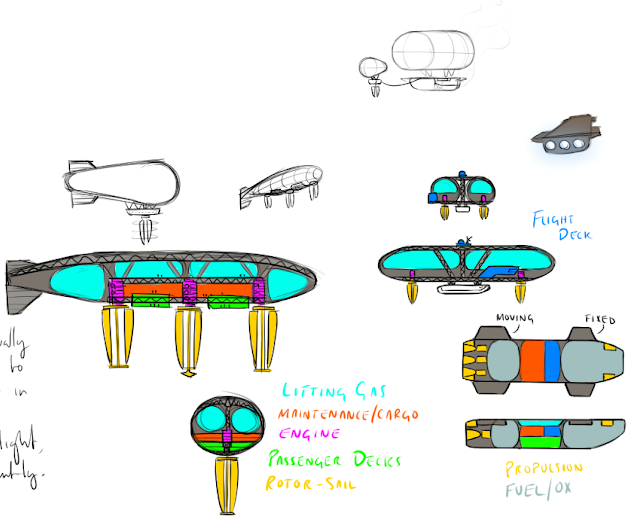
Here we see some sketches of a place I've called an "aircourt." To provide streamlined access to an ornate (spiky!) city, airships are afforded a series of high-altitude mooring platforms to spare them the trouble of navigating low amongst buildings. The linked towers enclose the eponymous "court" space. I imagine a steady stream of ships from all over the planet continuously feeding through the rows, some odd combination of the slowest airport in history and the most graceful aerial ballet ever devised.

What do these vehicles actually look like? I had originally envisioned grand sailing ships taking advantage of the continuous wind, but it turns out that's a bit too physically impossible for me to suspend disbelief. (If it only worked in real life, we'd probably have been flying them for decades.) Instead I pivoted to a cyclorotor design that approaches the original aesthetic and also provides a unique alternative to boring old props.
I'm pretty happy with the general aesthetic here, and the functionality is nice - cyclorotors (or, as they may be named in-universe, "rotor-sails") can produce a thrust vector in any direction within the plane normal to their rotation axis. In other words, airships with these installed can translate with immense precision and responsiveness, great for fighting those pesky winds or performing careful approach maneuvers.

You may be wondering with growing apprehension about the vehicle in the lower right. The catamaran airship above, with smaller rotor-sails, is an airlaunch platform. Smaller planets and a healthy dose of fantasy physics make airlaunched SSTO shuttles the most common passenger transport in the system. After being carried to their target altitude, the shuttles are released and power their way into orbit and beyond, chasing down big interworld cyclers (space stations on permanent transit paths, with accommodations like ocean liners). There they roost during the journey, detaching at their destination to reenter and land on their own.

Except, naturally, they actually deploy a stowed lifting gas envelope to "land" in midair, as illustrated by the sketch near the top there. That vehicle is shown being towed by a small tug balloon. Rides on these shuttles would be harrowing, but they're certainly the cheapest, and thus, most accessible, option for many people.

I have some older, more polished artwork that's relevant here:
This one depicts roughly the same vehicle as above. I may 3D model the design to codify some features; I shied away from the pointy winglets in favor of a stumpier, sturdier design. Also, I'm definitely avoiding naming a fuel type for anything anymore - these are certainly not hydrolox vehicles, and I'm not about to calculate mass fractions for these things.


Here we see a much older airship concept launching one of the shuttles. I'd like the vehicles in Roselight to have this level of whimsy; I'll just need to re-flesh them out beyond just the functional basics. Expect the end result to look pretty similar to this.


One of my favorites I've done, depicting a cycler sailing over Eterna on its way past pr'Sefone. The shuttles shown earlier would be dwarfed by this great liner, serving more as ship's tenders than spaceships on their own. The cycler is spacious and luxurious (results may vary by social class), although nobody stays very long...

I think it's about bedtime tonight, but hopefully this was somewhat interesting! I have a bit of a break coming up so I may try and get a few more posts in then.